Finding a hidden leak is one of the most frustrating problems a homeowner can face. You know something’s wrong – the water bill is creeping up, there’s a damp smell somewhere, or your floor feels slightly soft in a spot it didn’t before. But you can’t see anything. No visible dripping, no obvious wet patch. Just a problem you can feel but can’t find.
That’s exactly where tracer gas leak detection earns its place. Instead of guessing, cutting open walls, or jackhammering a floor on a hunch, this method finds the precise exit point of a leak – buried under concrete, hidden in a floor, or running under your yard.
What Is Tracer Gas Leak Detection and How Does It Work?
The concept behind tracer gas leak testing is straightforward. The system being tested is first drained of any liquid, then filled with a specially mixed gas – typically 95% nitrogen and 5% hydrogen, though helium is used in some situations. These gases are light, safe, and don’t naturally occur at high concentrations in the air around us, which makes them easy to detect when they appear where they shouldn’t.
Once the gas is pressurized inside the pipe or system, it starts pushing its way out through any crack or breach – no matter how small. From there, a technician uses a handheld sensor to locate it. There are two main approaches: “sniffing,” in which the sensor is passed over surfaces to detect escaping gas in real time, and “accumulation testing,” in which an area is sealed and monitored for gas buildup over a set period.
The whole process is completely safe. The leak detection with tracer gas are non-toxic and non-flammable, meaning they can be used in occupied homes, around water supply lines, and in commercial buildings without risk to people or property.
When Traditional Leak Detection Methods Are Not Enough
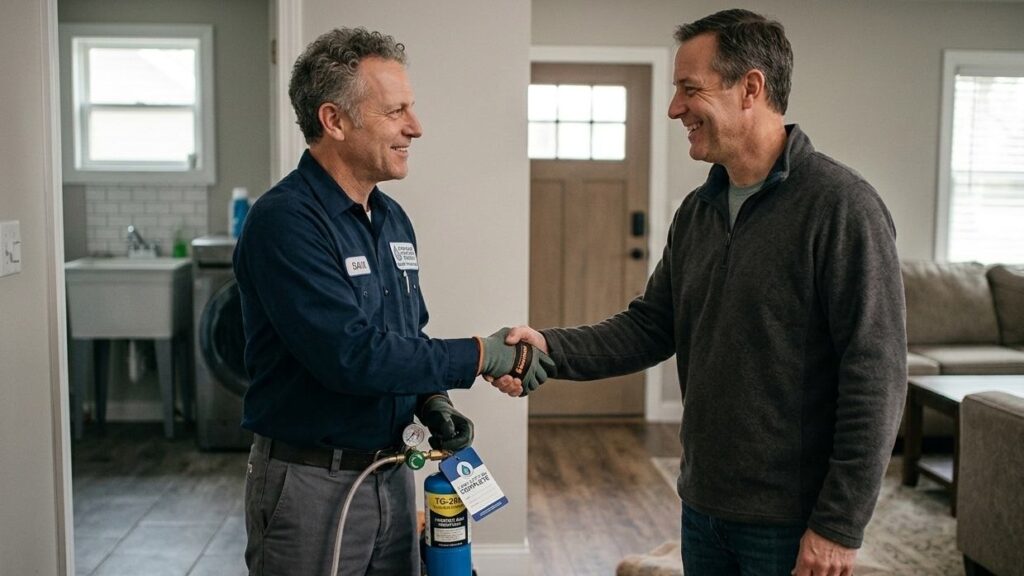
Most plumbers start with the standard toolkit – acoustic listening devices, thermal imaging cameras, and pressure gauges. These tools are useful, but they all have real limitations that come up more often than people expect.
Acoustic sensors pick up the sound of water rushing through a breach. But in a noisy neighborhood, or with a slow pinhole leak that barely makes a sound, they miss it. Thermal imaging shows moisture behind walls – but only if there’s a noticeable temperature difference, which isn’t always the case. Pressure testing can confirm that a leak exists somewhere in the system, but it won’t tell you where.
When these gas leak detection methods come up short, tracer gas leak detection is the logical next step. It doesn’t rely on sound, heat, or visual cues. It physically tracks the gas to the point where it’s escaping – which means it finds things the other tools can’t.
Common Situations Where Tracer Gas Testing Is the Best Choice
Tracer gas testing works best when the pipes or systems are completely out of sight, and the leak isn’t producing any obvious signs at the surface. If you can’t see it, hear it, or measure it with standard tools, this method cuts through the uncertainty.
Underground and Under-Slab Pipe Leaks
Buried pipes under soil or concrete slabs are some of the hardest leaks to locate – and the most expensive to get wrong. If you start breaking up a floor based on a rough guess, you can end up demolishing a large area and still not find the source.
A leak detection gas tracer is ideal for this exact situation. The gas molecules are small enough to move through soil and the tiny pores in concrete. Once the gas reaches the surface, it rises vertically from the leak point – so the technician can mark the exact spot before any digging or cutting begins. For homeowners with slab leaks, this can save thousands of dollars in unnecessary demolition.
Flat Roof and Waterproof Membrane Leaks
A flat roof or balcony can let water in through a puncture the size of a nail hole. But water doesn’t always drip straight down from where it enters – it travels along the membrane and shows up inside the building meters away from the actual breach. That makes visual inspection almost useless.
During tracer gas leak testing, gas is pumped underneath the waterproof membrane. The technician then scans the surface with a detector, and the gas rises directly through the damaged spot. For gravel-covered roofs or green roofs where you can’t see the membrane at all, this is often the only reliable method.
Heating Systems and Underfloor Piping
Radiant floor heating is great until something goes wrong. The pipes are embedded in concrete, completely out of reach, and the last thing anyone wants to do is tear up expensive flooring to find a small drip.
Leak detection with tracer gas can be done without touching the floor. The technician fills the heating circuit with the gas mixture and uses a detector to trace where it surfaces through the floor finish. It’s one of the cleanest, least invasive ways to deal with a problem that would otherwise require serious disruption.
Refrigerant and HVAC System Leaks
In large commercial HVAC systems, a refrigerant leak can be anywhere across a complex network of coils, joints, and valves. Standard electronic detectors sometimes give false readings due to background chemicals in the air, wasting time and leading to unnecessary parts replacements.
With a dedicated tracer gas detection approach, the tracer is entirely separate from the refrigerant – no confusion in the readings, no guessing. Technicians find the exact failing component and repair it fast.
How Tracer Gas Compares to Other Gas Leak Detection Methods
Among the various gas leak detection methods available today, tracer gas stands out for one key reason: it works with any sealed system, regardless of what it normally carries.
Acoustic sensors work for loud, high-pressure bursts. Smoke testing suits non-pressurized drains. Thermal imaging needs visible moisture or a temperature difference. All of them have blind spots – particularly for small, quiet leaks that produce no heat or sound.
Tracer gas leak detection covers those blind spots. It’s the most precise option for the silent leaks that other tools miss.
What to Expect During a Tracer Gas Leak Test
A technician isolates the section being tested, fills it with tracer gas, and pressurizes it. After a short wait, they scan with a handheld probe until the alarm triggers. Tracer gas leak testing typically takes one to four hours. Once done, the gas dissipates on its own – no residue, no smell, no cleanup.
Choosing the Right Leak Detection Professional
Not every plumber offers this service. The equipment is specialized, and the technique requires training to use accurately. When you’re looking for someone to run a leak detection gas tracer test, ask whether they use high-sensitivity hydrogen or helium detectors, and whether they provide a written report with photos and a marked location of the leak.
The best companies use tracer gas testing as part of a broader diagnostic approach – the precision step when other methods haven’t provided a clear answer. That’s what gets the repair done right the first time.If you’ve got a leak that no one else can find, Leak Experts USA can help. We use advanced tracer gas and detection technology across Las Vegas, Henderson, Summerlin, and surrounding areas. Call us at 725-677-2675 or book online – we’re available 24/7.